

Every forecast review I’ve sat in had at least one deal in it that was going to close because the customer liked us. The champion was enthusiastic. The demo went great. The notes in the CRM read like fan mail. And then the quarter ended and the deal didn’t, and nobody could say exactly why, because the reason was discussed in a meeting nobody from our side attended.
That’s the standing condition of any purchase big enough to need approval. Somewhere inside the buyer’s company, a buying group whose members have never all been in a room with you will decide whether to spend money on your product. The version of your argument that gets made in that meeting is whatever one of them remembered, edited down to what they’re willing to say out loud in front of their boss.
Matthew Dixon and Ted McKenna studied more than 2.5 million recorded sales conversations and reported in Harvard Business Review in June 2022 that 40 to 60 percent of deals end lost to customers who say they intend to buy and then fail to act. They trace it to indecision: the buyer’s own fear of choosing wrong, which nobody inside the company is willing to absorb on your behalf.
Who can stop the purchase
Robert Miller and Stephen Heiman, writing with Tad Tuleja in Strategic Selling in 1985, sorted members of the buying group into four types of influence: an economic influence that gives final approval, a user influence that lives with the product, a technical influence that screens suppliers out, and a coach on the inside. Their instruction was to start “by looking not for people, but for roles.” Forty years later the titles have changed, but the roles are still there.
What’s changed is that the buying group has grown and the veto has spread across its members. Procurement shows up to squeeze the price. Legal shows up to redline a contract that was fine last year. Behind both of them sits a security review with its own queue, its own standards, and no particular interest in whether anyone at the company wants your product. Each of them can stop the purchase and none of them can approve it.
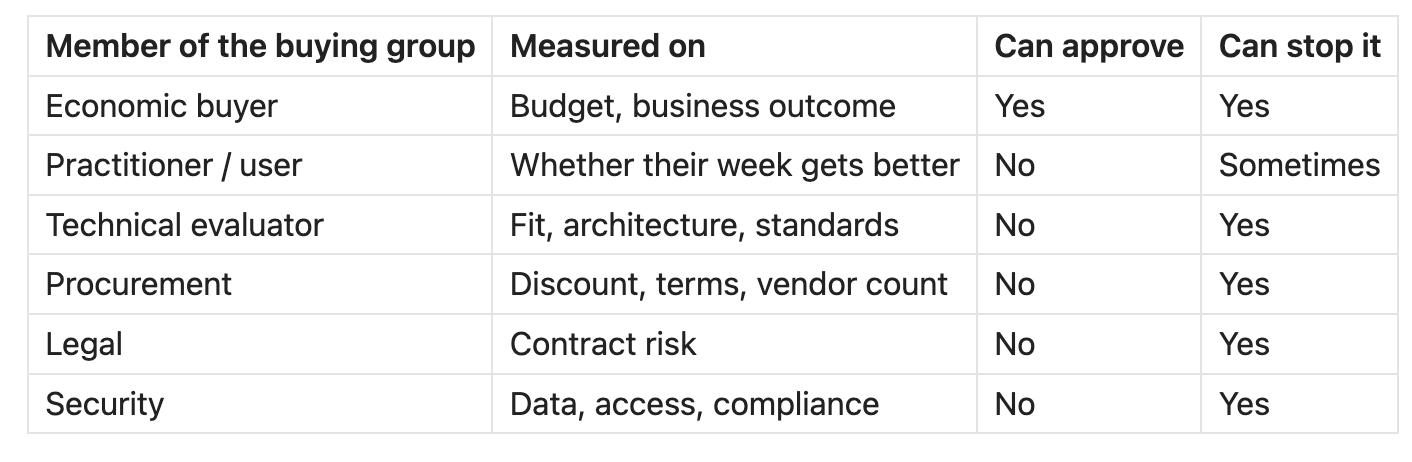
Add a member and you’ve added a way to die without adding a way to close, which is why the cycle stretches as the deal gets bigger.
The members also disagree about what counts as a good reason, because each one answers to a different boss and gets measured on a different number. A change that helps one of them lands on someone else’s ledger as a cost. The return-on-investment model that settles the finance conversation bores an engineer into suspicion. The architecture walkthrough that wins the engineer loses finance inside a minute. Pitch the average of the room and you persuade nobody, since a buyer wants their own blocker removed, and a general account of why your product is good doesn’t remove it.
Companies have bought this way for as long as anyone has sold to them. I’ve argued before that the single hand raised on a single form is a poor proxy for a decision that ten or twelve people actually make, and that the honest metric is how far into that group you’ve reached. You can reach the group, and you still won’t be in the room when it decides.
I watched an infrastructure company win an engineering team so completely that its logo went on the customer’s internal wiki as “the standard.” We read that as sold and forecast it accordingly. Then somebody in security sent over a questionnaire asking where the data would physically live, and the deal sat untouched for a quarter while one document got written. The product hadn’t changed. The engineers still wanted it. Nobody had ever assigned that review an owner, and it was holding the decision. Answering it is what closed the deal, roughly ninety days after the forecast said it would.
The blank on your map is almost always security or procurement, and the reason isn’t mysterious. Your call log is built out of people who wanted to talk to you. The people who can stop a purchase have no reason to want to talk to anyone. Draw a map from your own calendar and you get a map of your friends.
The member who wants you to lose
Steve Blank found a member of the group that no map of persuadable people contains. In The Four Steps to the Epiphany, he identifies a group he named himself (his coinage, and he says so in the passage). “I call this group the saboteurs. In every large company, for example, there are individuals and organizations that are wedded to the status quo.”
The saboteur is defending their own position: the headcount, the budget, the system they built and are known for running. Your product working is what threatens it, so a better argument about your product changes nothing that matters to them. And they can’t say so, because objecting to a purchase everyone else wants makes them the obstacle. The refusal gets handed to a colleague with a cleaner reason to raise it and reaches you as a budget concern or a sensible-sounding question about integration risk that nobody can quite source.
Pitch harder and they defend harder. Identifying the saboteur gives you the ability to route around them and to stop reading their silence as agreement. Nobody volunteers the saboteur by name, so you have to ask an insider a faintly rude question: who here is worse off if we win? In my experience people answer it and quickly. They’ve often been waiting for someone to ask.
How to tell a champion from a contact
The person who makes your case when you aren’t there has a name in every sales framework. MEDDIC calls them the Champion and makes them one of six things a salesperson has to establish before a deal counts as qualified. Miller and Heiman call them the Coach. None of them tells you how to work out which person it is.
People show you where they stand by what they’re willing to spend. Warm words in a meeting are free, and people give them away to be pleasant. The champion’s work is done when you aren’t there to see it: your one-page summary forwarded without being asked, a warning about the other members that nobody was obliged to give you (legal will care about data residency, get ahead of it), and an internal thread you had no way of knowing existed and are suddenly on. Each of those costs the champion a little of their own standing, and you can’t buy it or reimburse it.
When somebody inside vouches for your product, they attach their own judgment to it in front of people who will remember. If a claim you made falls apart under their manager’s questions, you lose a deal and they lose standing they need for everything else they do there, which is much the worse end of the trade. That is why overselling to a new champion works against you: it raises the odds they get caught holding a claim they can’t defend, and once that happens they stop spending on you. Telling them plainly what your product doesn’t do yet is what keeps them able to speak for you at all.
One moving part
You can’t appoint a champion. What you can do is make it easy for somebody to look smart in front of their boss. You can’t direct what they say in the room. Usually the outcome is all you get. Their candor is what preserves their capacity to advocate.
Every other input in a go-to-market plan is something the company owns or buys and can therefore fix when it breaks. This one is on loan from a person with a manager and a career of their own, who owes you nothing and can stop at any point without telling you or leave the company entirely and take your argument out of the building with them.
The repair is obvious: find a second advocate in a different role while the first one is still there and still enthusiastic and the whole thing looks like it’s going fine. It will feel unnecessary every time, which is why it rarely happens. The moment the need becomes obvious is the moment the opportunity has gone.
Write for the retelling
The argument that decides the deal is a secondhand version of yours. So the thing worth working on is how well it survives being repeated by somebody else, from memory, to a skeptical audience in about ninety seconds.
That changes what you make. Build the one page they can forward without editing it. Give them the number they can say out loud and defend if somebody asks where it came from. Make sure they can answer the hard objection alone, in your absence, without calling you first. A demo that only works when you’re driving is not evidence they can use.
Then check it: could this person defend the purchase for two minutes with you out of the building? If they can’t, more meetings won’t help, because a meeting puts the argument back in your mouth instead of theirs. It’s why the best sellers I’ve worked with spend so much time on things that don’t look like selling. They’re getting one person ready for a conversation they’ll never hear about in a room they were never going to be in.