

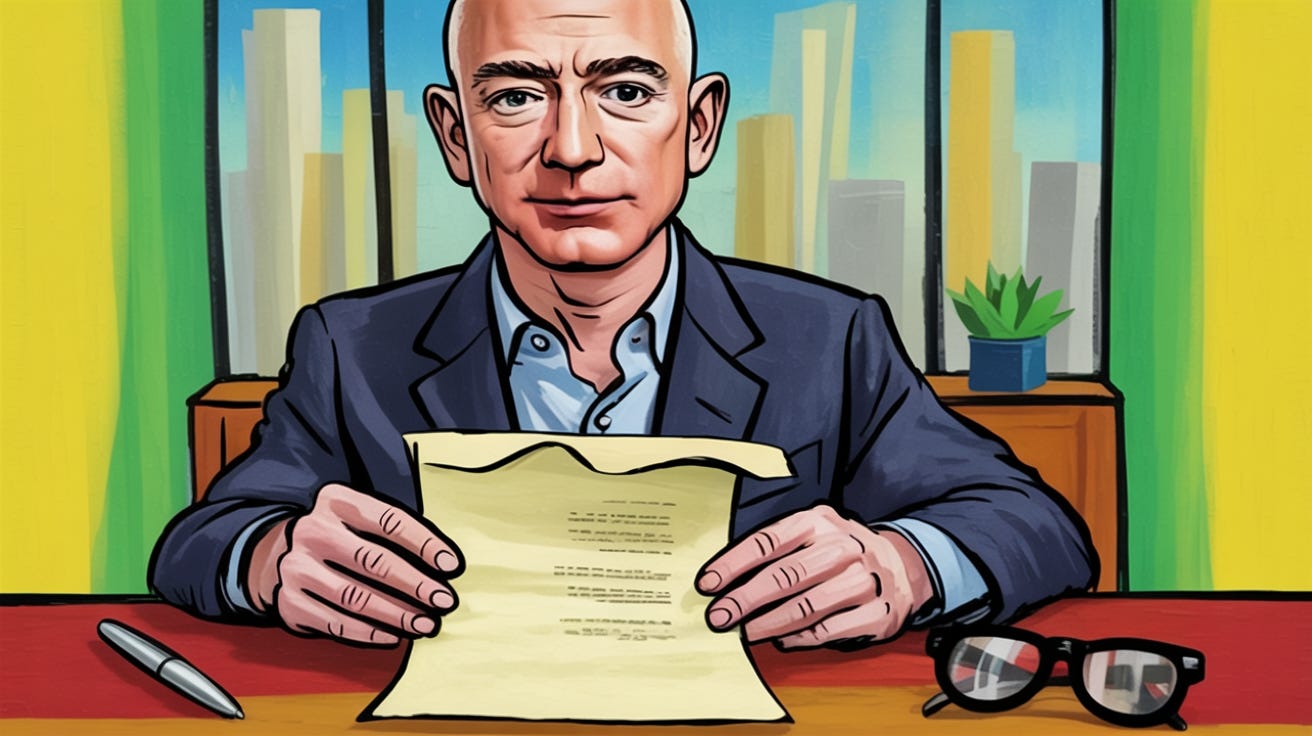
Jeff Bezos pushed back from his chair and told Anthony Reeves to throw away six weeks of work. Reeves should come back in four to six months, Bezos said, once he understood how Amazon worked. Then he should write the document again from the customer’s point of view: what Amazon would deliver for her, rather than what Amazon could build and monetize. Bezos left before Reeves said a word.
Amazon had hired Reeves in 2015 to run creative for Amazon Media Group. His team had flown colleagues in from around the world to produce a Working Backwards memo, the six-page format Amazon calls a PRFAQ. Reeves wore a collared shirt instead of his usual untucked T-shirt. A container of red Bic pens sat alone on the light grey table.
Because Amazon meetings open with silent reading, Reeves spent thirty minutes listening to pens scratch and people grunt over the pages. In Eat the Donkey, he says he suffocated in the silence.
His thesis was right: Amazon should pursue brand advertising alongside retail and search. In its 2015 annual report, Amazon reported $1.02 billion from everything outside retail and AWS, a category that combined advertising with its co-branded credit card business. By 2025, advertising services alone brought in $68.6 billion.
The analysis held up, but the memo failed because its four sections covered the revenue opportunity, competitors, technical capabilities, and market size, so every page described Amazon. Reeves had spent twenty years in agencies learning to understand customers, yet his training had produced an excellent answer to the question founders find easiest to ask: what can our company sell?
The questions your board asks point inward
Your board wants to know what you can build, which assets you can reuse, and how large the market is. It can run through those questions before lunch, and each answer gives you a number or a slide. Together they assume the world already cares what your company can do.
Agencies have an industrial version of the same mistake. A brief starts with what the client wants to say, and the team finds ways to make people listen. The customer appears as a persona, which lets everyone sell to her without thinking about her. A seed deck often does the same work in different vocabulary, opening on the architecture and reaching a human somewhere around slide nine.
The dangerous part is that a spreadsheet and thirty customer conversations can produce artifacts that look identical: six confident pages, numbers, and a recommendation. The difference sits upstream in how you gathered the evidence. I’ve argued that the argument that decides your deal is a secondhand version of yours, repeated from memory in a room you never enter. A pitch written entirely inside your building gives the buyer little she can repeat.
Thirty conversations changed the document
Reeves spent the next five months with Amazon’s retail teams, sellers who already bought ads elsewhere, and agencies trying to spend money on Amazon. He visited distribution centers and kept asking what worked, what failed, and what sellers wished they could do on Amazon.
Your interviews need the same discipline because describing the product and asking whether someone would use it turns the customer into a grader for your idea. Ask her to reconstruct the last time the problem occurred, including what she did next, whose budget paid for the workaround, and what happened when nobody fixed it. Her answers describe behavior that already occurred. A founder needs evidence strong enough to cancel a roadmap item, and polite enthusiasm rarely clears that bar.
The answers described outcomes. “We can offer targeted display advertising” became “sellers want to help shoppers find products they didn’t know to look for.” “We can provide detailed analytics” became “sellers want to know which buyers come back and which buy once.” Although the underlying capability stayed the same, the new language named a person and a job she needed done, so teams could decide what to build.
CarMax began with the same discipline when it started in 1993 around one observation about how people feel in a dealership: they hate negotiating. CarMax built the business around posted prices and sold $25.9 billion of used cars in in FY 2026.
Founders like to pitch big markets because they look good in the deck. A better measure is what customers already spend to solve the problem. If they’re paying for a workaround in money or time, the problem is real enough to act on. I’ve argued that a wedge is one problem somebody is already paying to work around, and you have to leave your building to find it.
Five months later, Reeves carried a second six-page memo into a smaller room. This version explained what advertising on Amazon would do for a shopper. The silent read became a conversation about what Amazon should build, with customer outcomes guiding the revenue opportunity.
The pressure to ship distorts what you hear
Customer obsession may appear on your careers page and in your investor update. Your operating calendar keeps dragging attention back to the company.
The board meets every quarter and the next round has a date attached. Soon the governing question becomes what you can show by then, even though customer problems don’t arrive on your financing schedule. The same pressure reaches your first rep, whose compensation depends on a number due this quarter. I’ve never met a good salesperson who was confused about which deadline wins.
What you’ve already built exerts its own pressure: the codebase, the demo that closes, and the architecture you described to investors. Building around those assets feels responsible until customer evidence tells you that eighteen months of engineering solved the wrong problem. When we called Mesosphere’s product a Data Center Operating System, we aimed at a larger budget line. The description was accurate, but it grew from what we already had and held for about eighteen months, until Kubernetes was free and we weren’t.
Your data adds another pull because nearly all of it describes your company: signups, activation, funnel stages, and usage logs. Customer frustration lives in sentences nobody has collected, so you improve what you can measure while the evidence that could change your strategy never enters the system.
The correction gets more expensive every quarter
Thirty customer conversations aren’t something a founder delegates. The person who may have to change the strategy needs to hear the sentences herself. A research firm returns a deck, leaving you with one more document to interpret. Doing the work costs founder time this quarter and may produce nothing you can show in the first month.
The work also adds cycle time, and Reeves spent five months correcting course because Amazon could afford the wait and Bezos stopped the first memo. A startup usually sends the deck, builds the product, and lets the market reject the argument. By then the correction costs quarters of runway instead of weeks of rework.
A rare capability may have to exist before any customer can ask for it, but the discipline still applies: ask early who needs it and accept that the answer may be nobody yet. Customers can’t design your product for you; a good interview gives you a workaround, the frustration behind it, and its price. Turning those facts into something worth buying remains your job.